Textile Quality Checklist with AQL Table
For textiles, you check samples, material, measurements, seams, colour, labels and packaging in three phases: before, during and after production. For the final inspection, an AQL plan under ISO 2859-1 sets how many pieces are drawn from the lot and how many defective pieces are still acceptable. The checklist and table below apply to general inspection level II.

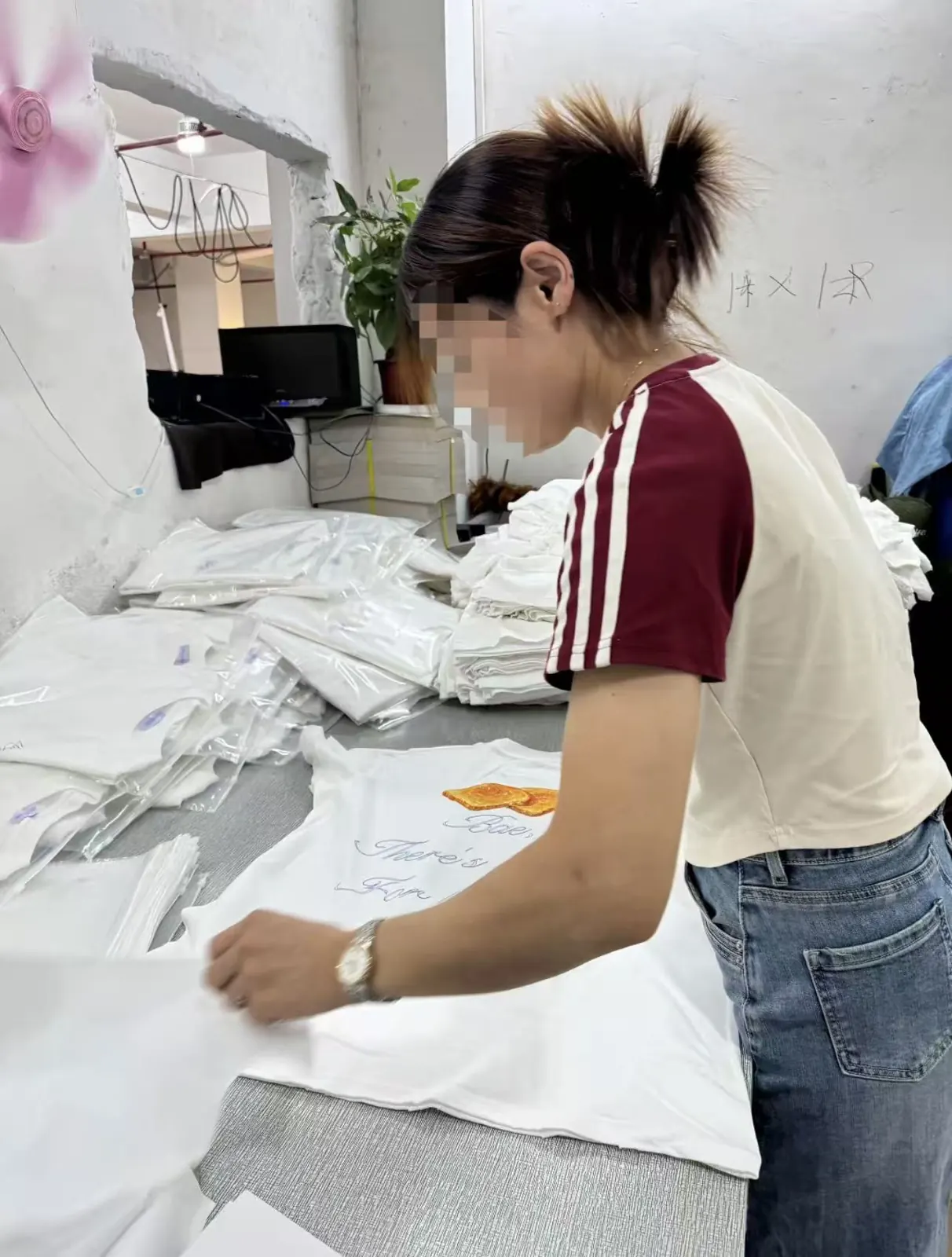
What is checked before production?
Most quality problems are already built in before the first piece is cut. So check the basics first:
- Sample: The approved sample (golden sample) is the benchmark for everything that follows. Record the approval and any deviations in writing, ideally with photos.
- Technical drawing and measurement chart: Measurements with tolerances, seam type, stitch density and workmanship notes should be settled before production.
- Material: Fabric type, composition and weight per square metre, test reports where needed. Check goods from the first fabric delivery against the sample.
- Trims and labels: Zips, buttons, thread, care and size labels, and the mandatory information for the target market.
Settling these points in writing saves the later discussion about what was "agreed".
What is checked during production?
A check as soon as the first series pieces come off the line shows whether the series behaves like the sample. On the line, check:
- Seams: Stitch density, even course, seam strength, bar tacks at stress points, open or skipped stitches.
- Measurements: Spot measurement across several sizes against the measurement chart, including tolerances.
- Colour: Comparison with the sample under the same light, deviations between batches and within a piece.
- Fit and appearance: Does the fabric wrinkle, does a piece twist, are prints or embroidery in the right place?
A check during production has the advantage that an error can still be corrected. Once the goods are packed, every piece of rework costs time and money.
What belongs in the final inspection?
The final inspection takes place when the goods are almost fully produced and most of them are already packed. A sample is then checked according to AQL:
- Quantity and packing units: Pieces per size and colour, carton marking, carton dimensions and weight.
- Appearance and workmanship: Stains, holes, loose threads, sewing defects, print or embroidery defects.
- Measurements: Spot measurement against the measurement chart.
- Labels: Size, care and origin labels, composition, barcodes, placement.
- Packaging: Polybags, individual packaging, labelling, closure and carton quality.
- Functional tests: Zips, buttons, snap fasteners and, where needed, colour fastness to rubbing.
Defects are divided into three classes. Critical defects endanger people or breach regulations, for example protruding sharp needles. Major defects make the product unusable or would be noticed by the customer, for example an open seam or a wrong measurement. Minor defects are small flaws that hardly affect use or appearance. You define the classes in writing before production.
How does AQL sampling work?
AQL stands for Acceptable Quality Limit, the highest defect rate that is still considered acceptable for a delivery. ISO 2859-1 describes sampling plans for it. The procedure is always the same:
- Establish the lot size, that is, the number of pieces in the delivery being inspected.
- Choose the inspection level. General level II is usual. Level I means less effort, level III more.
- Read the code letter, and with it the sample size, from the lot size.
- Draw that many pieces at random from several cartons and inspect them.
- Compare the defects found per class with the acceptance number. If the number of defects is at or below the acceptance number, the lot is accepted. If it reaches the rejection number, it is rejected.
Which AQL values you choose is a matter for negotiation. Usual in the industry for apparel are no critical defects (value 0), AQL 2.5 for major and AQL 4.0 for minor. A stricter value means a larger sample or fewer permitted defects and thus more inspection effort. Agree the values before ordering, otherwise you will argue after the inspection.
What does the AQL table for level II look like?
The table shows single sampling plans for normal inspection at general inspection level II. Ac stands for the highest permitted number of defects, Re for the number of defects at which the lot is rejected.
| Lot size | Code letter | Sample size | AQL 2.5 (Ac / Re) | AQL 4.0 (Ac / Re) |
|---|---|---|---|---|
| 91 to 150 | F | 20 | 1 / 2 | 2 / 3 |
| 151 to 280 | G | 32 | 2 / 3 | 3 / 4 |
| 281 to 500 | H | 50 | 3 / 4 | 5 / 6 |
| 501 to 1,200 | J | 80 | 5 / 6 | 7 / 8 |
| 1,201 to 3,200 | K | 125 | 7 / 8 | 10 / 11 |
| 3,201 to 10,000 | L | 200 | 10 / 11 | 14 / 15 |
| 10,001 to 35,000 | M | 315 | 14 / 15 | 21 / 22 |
Example: for 5,000 hoodies the code letter is L, so 200 pieces. At AQL 2.5 the inspection may find up to 10 pieces with major defects. At the 11th defective piece the lot is rejected.
Lot sizes below 91 and above 35,000 pieces are deliberately left out. There the sources differ on sample sizes, because plans refer to other rows. For these lots, use the original standard. If the sample size is as large as the lot, the entire lot is inspected. The table values are for orientation, and the standard is authoritative.
How do I use the checklist in practice?
A checklist only helps if it has been agreed with the factory before production. These are the points we advise a buyer to follow:
- Write defect classes, AQL values and inspection level into the order or the supply contract.
- Include the golden sample and the measurement chart as an annex.
- Plan at least one inspection during production and a final inspection.
- Appoint an inspector who is independent of the factory and require an inspection report with photos.
- If the lot is rejected, clarify in advance who reworks, who pays and how re-inspection is carried out.
The checklist is also available in a printable version, with tick boxes, fields for order data and the inspection result, and the AQL table: Download the textile quality checklist as a PDF (4 pages, A4).
How we carry out quality control on site is described on the quality control page. If you are planning a production run, you can describe your case to us through the enquiry form.
Sources
- ISO 2859-1: Sampling procedures for inspection by attributes, Part 1: Sampling schemes indexed by acceptance quality limit (AQL) for lot-by-lot inspection (ISO)
- Apparel Search: 2.5 AQL Chart for the Fashion Industry and 4.0 AQL Chart for the Fashion Industry
- QIMA: Acceptable Quality Limit (AQL) (cross-check of the values; QIMA refers to ANSI/ASQ Z1.4, the US counterpart of ISO 2859-1)
Frequently asked questions
What does AQL mean?
AQL stands for Acceptable Quality Limit, the highest defect rate that is still considered acceptable for a delivery. Together with the lot size, it determines how many defects are permitted in the sample.
Which AQL values are usual for textiles?
Usual are no critical defects, AQL 2.5 for major defects and AQL 4.0 for minor defects. You agree the values with the manufacturer before ordering.
How many pieces are inspected for 5,000 units?
At general inspection level II the code letter is L and the sample is 200 pieces. At AQL 2.5, at most 10 pieces with major defects are permitted.
When should the final inspection take place?
Usually when the goods are almost fully produced and mostly packed. The sample is then representative and there is still time for rework.
Co-Founder · Beijing
Felix Sander
Your contact for new brands and coordination with manufacturers. He brings together product requirements, samples and quality directly on site. He studied at Beijing Foreign Studies University and Montgomery College and previously worked in green coffee trading.